
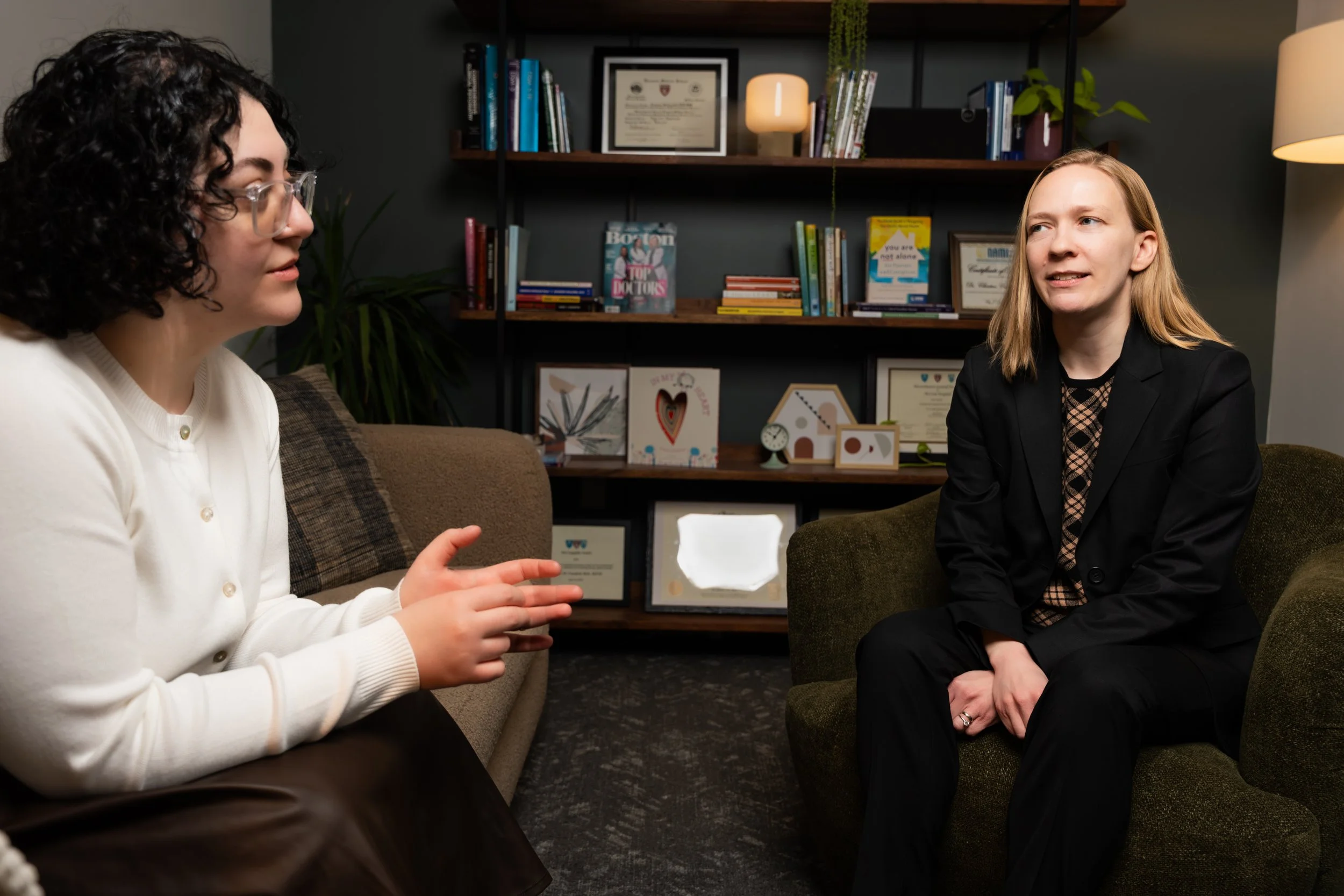
Anxiety Psychiatry in Boston
Space to understand your anxiety — not just manage it — and make lasting change.
Physician-led psychiatry combining psychotherapy and medication with one clinician
Psychodynamic and CBT-integrated treatment for anxiety across all ages, from children to adults
In-person in Boston’s Back Bay, with telehealth available for established Massachusetts patients
1.
Request a consultation:
Submit the form or call.
2.
Office manager call:
We review basic clinic information and fit.
3.
Brief clinician screening (10–15 minutes):
Then our office manager books your first appointment.
Private-pay care enables time, continuity, and depth, with fees discussed during the office manager call.
Located in Back Bay and serving Beacon Hill, Brookline, Cambridge, Somerville, Newton, and surrounding areas. Telehealth is available for established patients in Massachusetts, and for new patients where in-person care is not accessible.
Appointments are often available within a week.


OUR APPROACH
Curiosity-first: we ask why the anxiety developed, not only how to reduce it
Psychodynamic and CBT-integrated, drawing on both depth and structure
Medication as a tool when it helps, woven into a larger therapeutic relationship
Child, adolescent, and adult psychiatry from one clinician
How We Think About Anxiety
Most anxiety treatment focuses on symptom reduction which is often necessary. But anxiety that keeps returning, or that has only partially treated before, usually has roots worth understanding. Below is how we hold that clinically. (Anxiety and depression frequently co-occur — see our Depression page)
-
Anxiety usually makes sense in context
Anxiety is often a response to something real: an environment that was unpredictable, a relationship that required vigilance, or a self-concept that came to depend on performance. We pay attention to where the anxiety came from, not only where it shows up.
The body and the mind are in the same conversation
Panic, insomnia, nausea, and muscle tension are not separate from psychological anxiety — they are part of it. Our treatment attends to the physical experience of anxiety as well as its cognitive and relational dimensions.Chronic anxiety can narrow a life
Avoidance, overwork, perfectionism, and people-pleasing are common anxiety-driven patterns that look functional from the outside. In treatment, we look at what anxiety has shaped in how you move through the world — and what it might be protecting.
Who We Work With
Adults
Generalized anxiety, social anxiety, panic disorder, health anxiety, performance anxiety, anxiety in high-achieving professionals, and anxiety that has been present since childhood but never fully treated in adulthood.
Teens and Young Adults
School and campus anxiety, social anxiety, separation anxiety, anxiety about the future, and the particular pressure of adolescence in a high-expectation environment. Adolescent treatment has important elements.
Children (ages 5+)
Separation anxiety, selective mutism, school refusal, worry, and somatic complaints (stomachaches, headaches) with an anxiety component. Parent guidance included with child treatment.
People with complex presentations
Anxiety alongside depression, OCD, ADHD, trauma, or a prior treatment history that only partially helped.
What we help with
Generalized anxiety disorder (GAD)
Social anxiety disorder
Panic disorder and agoraphobia
Health anxiety and illness anxiety
Performance anxiety and perfectionism
Separation anxiety in children and adolescents
School refusal and selective mutism
Anxiety in the context of ADHD, OCD, or trauma
Anxiety during major life transitions: divorce, immigration, career change, college
Anxiety in LGBTQIA+ individuals related to identity, family, and minority stress
Anxiety in professionals and people of color navigating high-pressure environments
-
Your work is going well. Your calendar is full. But you sleep badly, your jaw is tight, and you have not felt genuinely calm in years. We work with anxiety that hides behind productivity — and help you understand what it is actually about.
-
Stomachaches every Monday. Crying at drop-off. A child who is bright and social at home but freezes in the classroom. We treat school-refusal anxiety in children and adolescents, and work closely with parents and schools.
-
Heart racing, chest tight, certain something is wrong. Panic disorder often arrives without an obvious trigger. We help you as an adult understand its roots, reduce its frequency, and stop organizing your life around the fear of the next attack.
-
![A woman sitting in a green armchair with a bookshelf behind her, smiling at the camera.]()
Jacqueline Buchanan MD
Child, adolescent, and adult psychiatrist
-
![]()
Cecil R Webster Jr MD
FOUNDER & CEO
Child, adolescent, and adult psychiatrist
Psychoanalyst


FAQs
Do you treat anxiety with therapy, medication, or both?
1
Both, and we decide together. Some patients benefit most from psychotherapy alone. Others find that medication reduces the physical intensity of anxiety enough to make therapy more productive. Because our psychiatrists provide both, the decision is made within a single relationship — not handed off between two clinicians.
What type of therapy do you use for anxiety?
2
We draw on both psychodynamic therapy and cognitive behavioral therapy (CBT), depending on the patient and the presentation. CBT is highly effective for specific anxiety disorders and we use exposure-based techniques when indicated. Psychodynamic work helps when anxiety is rooted in relational patterns or history that needs to be understood, not only managed.
Do you treat anxiety in children?
3
Yes. All three of our psychiatrists are board-certified and work as child and adolescent psychiatry as well as adult psychiatry. We see patients from age five through adulthood for anxiety treatment, including school refusal, separation anxiety, and selective mutism.
How is treating anxiety at Webster Clinic different from seeing a therapist?
4
Our clinicians are physician-psychiatrists, which means they can prescribe medication and provide psychotherapy in the same relationship. You do not need a separate prescriber. This is particularly useful for anxiety that has a significant physical component or has not responded to therapy alone.
Do you offer telehealth for anxiety treatment?
5
Yes. Telehealth is available for Massachusetts residents. New patients can often be seen within one to two weeks.
Do you see patients with anxiety and another diagnosis, like ADHD or depression?
6
Yes. Anxiety rarely presents alone, and we are experienced with complex presentations including anxiety alongside ADHD, depression, OCD, and trauma.
Why choose a board-certified psychiatrist instead of a psychiatric nurse practitioner?
7
Both can be helpful, but a board-certified psychiatrist (MD/DO) brings full medical training and specialty residency, which matters for complex diagnosis, medical differentials, and nuanced long-term prescribing. In addition, all of our psychiatrists are experienced psychotherapists and/or psychoanalysts. We provide ample depth and breadth to treat your condition. Our model keeps prescribing embedded in an ongoing therapeutic relationship, not a protocol-only visit.
What does private-pay enable clinically?
8
Private-pay care protects time, continuity, and depth. It allows longer, unhurried evaluations, steadier follow-up, and treatment guided by clinical need rather than insurance-driven visit limits, diagnosis requirements, or fragmented “split” models of care.
How quickly can I be seen?
9
Appointments are often available within a week.
Yes. We offer in-person care in our comfortable Back Bay office and periodic telehealth for established patients. While we are located in Back Bay we also serve Beacon Hill, Brookline, Cambridge, Somerville, Newton, and surrounding areas.